Trace Brewing has paused many of its popular events after an ongoing dispute over indoor noise complaints from nearby residents and Pennsylvania Liquor Control Enforcement (PLCE) escalated in recent weeks.
The Bloomfield brewery, known for hosting drag performances, DJ nights, live music, and community events, announced on social media that it would suspend much of its programming while it navigates continued enforcement by the PLCE.

Trace Brewing opened its doors in 2020, during the height of the COVID Pandemic. As a result, most of its programming and events were held outside in its beer garden. After neighbors reported Trace to the PLCB in 2024, Trace stopped all outdoor events and moved them inside its Taproom. For the last two years, some of the artists and musicians continued to hold outdoor events on Clement Way next to the brewery by pulling Special Events Permits issued by the city of Pittsburgh, sparking a new wave of concerns by neighbors.
While Trace has become the face of the issue, Dave Kushner says the law affects any licensed business hosting amplified entertainment in Allegheny and Philadelphia counties.
Why This Matters
At the center of the dispute is Pennsylvania Liquor Code, 47 P.S. § 4-493(34), which states that a liquor license holder “may not use or permit the use of a loudspeaker or similar device…whereby the sound of music or other entertainment…can be heard beyond the licensee’s property line.”
In practical terms, if a PLCE officer can hear amplified music beyond a licensed property’s boundary, the business can be cited.
Although that provision exists in Pennsylvania law, Act 67, passed during the pandemic, exempted every county from the requirement except Allegheny and Philadelphia counties, leaving licensed businesses in those two counties operating under different rules than the rest of the state.
Kushner says that standard makes it difficult for breweries and other licensed businesses to host live entertainment. “The regulation is written so that it is impossible to comply. This allows enforcement to be applied inequitably to different businesses. It allows a neighbor to weaponize the law against a business that is operating exactly like one located 2 blocks away.”
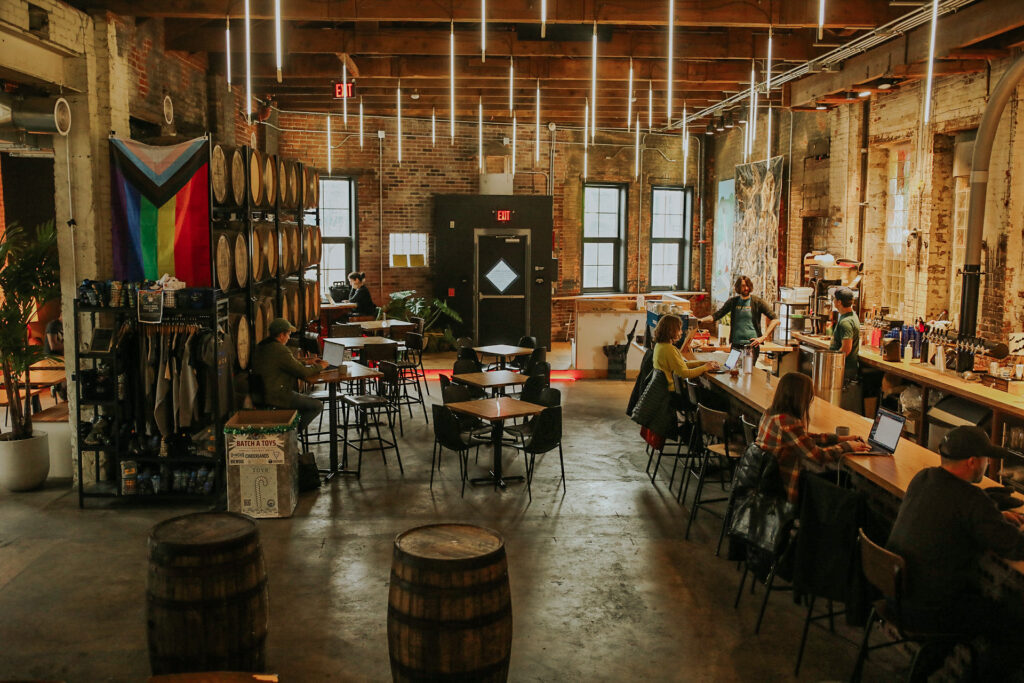
“The issue of noise is fundamentally local in nature,” Kushner said during a Pittsburgh City Council discussion. “If a neighbor feels like their quality of life is being affected, there should be a requirement to sit down with the business and work toward a solution.”
The brewery had applied for an amusement permit in 2024. After nearly two years, this application was denied by the PLCB, meaning Trace cannot officially host certain entertainment on its licensed premises. Trace says the presence of PLCE officers at recent events that did not require an amusement permit contributed to its decision to pause programming.
“Trace prides itself as a safe space for all. It would be disingenuous to tell our guests this is a safe space while plainclothed, conceal-carrying state police officers are inside our taproom in response to simple noise complaints. Officers responding to these complaints are not performing any public safety duties”, said Kushner. Instead, many outdoor events have continued under city-issued street closure permits while Trace remains open to the public next door.
Kushner says he plans to continue working with local officials and industry organizations to pursue changes that would allow municipalities to regulate noise locally instead of through state liquor enforcement.
For now, Trace’s signature events remain on hold while discussions continue, but the outcome could have implications for breweries and other licensed businesses across both counties.